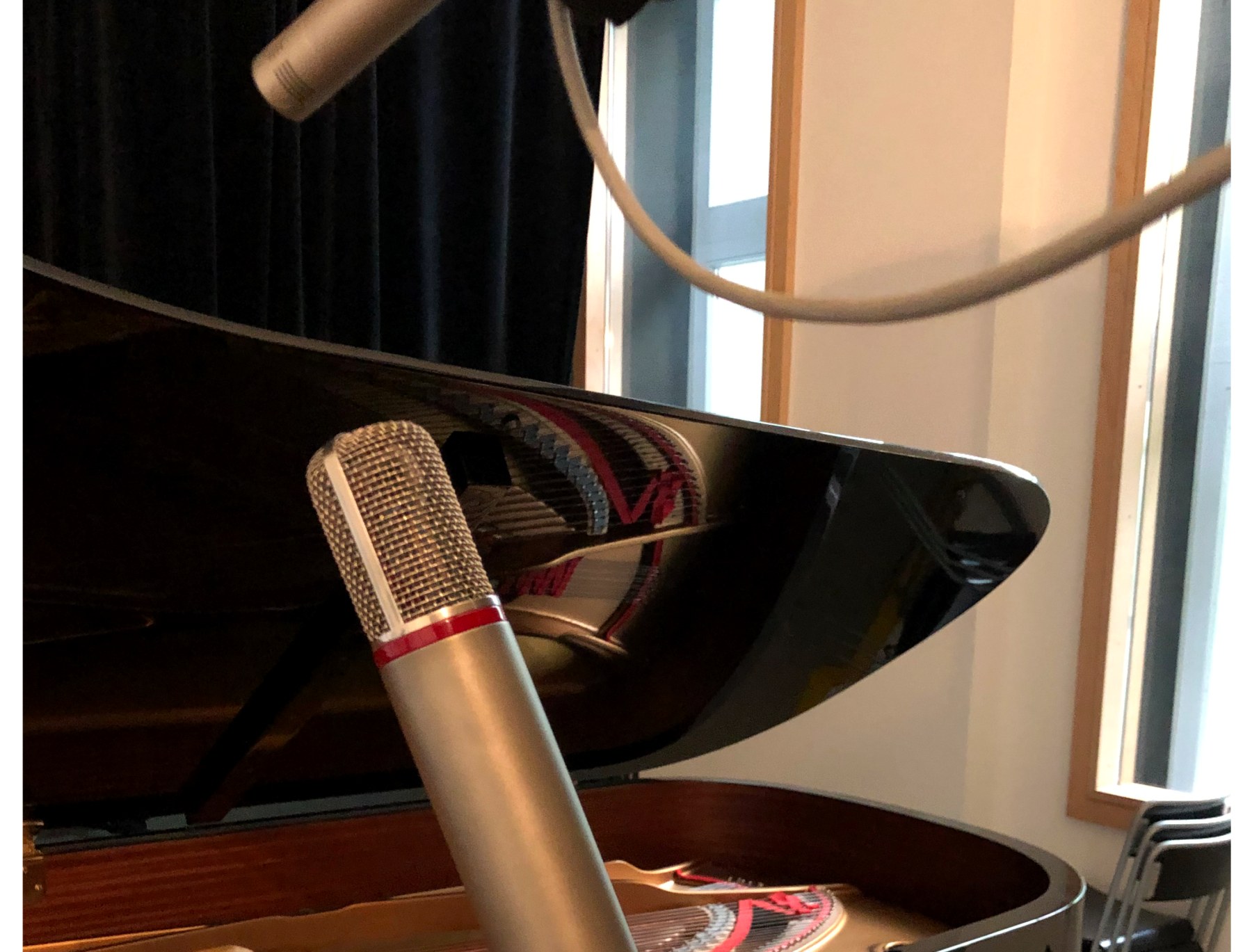
The room is the first instrument
A classical recording is not made in post-production but in the choice of room, placement and microphone technique. Vienna has concert halls, churches and library halls with outstanding acoustics — and MB Records works mobile so that recordings can be made exactly there. We advise in advance on choosing a suitable venue and on coordinating with the promoter.
Recordings are made with a main microphone system plus spot microphones: a natural image of width, depth and dynamics as it was heard in the room — not a sound assembled from individual tracks.
What we record
- Orchestra and choir — concert recording or studio production, including the dress rehearsal as safety material.
- Chamber music — duo to ensemble, sessions with a producer reading the score.
- Solo piano — recorded on a concert grand in the hall; tuning and instrument by arrangement.
- Voice and song — Lied duo, arias, oratorio.
- Audition and demo recordings — for competitions, auditions, agencies and conservatoires.
- Live broadcasts — radio and streaming productions, regularly for Radio 100,7 / opus 100,7.
From session to master
After the sessions comes editing from the score: takes are joined by musical criteria, not by waveform. Then mixing and mastering in stereo, surround or immersive formats up to DSD and Dolby Atmos, a correction round with the artists, and finally delivery of broadcast-ready or pressing-ready masters complete with metadata.
If a release is planned, that is part of the work too: approaching labels, contracts, format requirements and schedule belong to the production — not as an add-on but as part of the advice. More about the producer: Marco Battistella.
Equipment
Recordings are made with converters and recording systems by Merging Technologies and Pyramix, with microphones by Neumann, Telefunken, AKG, DPA and Schoeps. Post-production in Pyramix and Pro Tools, immersive up to Dolby Atmos; monitoring on Audeze and Beyerdynamic as well as Kii Audio.
The equipment comes to the music, not the other way round: the complete system is mobile and assembled for each production according to room and forces.
References
More than 40 released productions, among others for NAXOS, Hänssler Classic, Rubicon, Luxembourg Classics and Ars Produktion. Regular live broadcasts for Radio 100,7 / opus 100,7, recordings for concert halls and orchestras in Austria, Luxembourg and Germany.
Marco Battistella is a voting member of the Recording Academy and a member of the Verband Deutscher Tonmeister (VDT) and the Austrian Tonmeister association (ÖTMV). More on Wikipedia (German); the full discography is on the home page.
Frequently asked questions
Where in Vienna can classical music be recorded?
In principle in any acoustically suitable room: concert halls, churches, halls with a concert grand or rehearsal halls. Since MB Records works mobile, the choice depends on forces and repertoire; suitable rooms are recommended in the preliminary discussion.
How long does an album production take?
For an album of around 60 to 70 minutes of music, depending on forces and difficulty, usually two to three recording days plus post-production. Concert recordings need the dress rehearsal and the concert.
Can a concert that has already been played be released afterwards?
Only if it was recorded. That is why it pays to record concerts in release quality from the outset — the decision about an album can be made later.
Do you also record for competitions and auditions?
Yes. Demo and application recordings are made with the same recording method and delivered in the formats required by competitions and conservatoires.
Who owns the rights to the recording?
That is settled in writing before the production. Usually the artists or the client receive the usage rights to the recording; for label releases this follows the label contract.
More services
Enquiries
Please send enquiries via the contact form on the home page — with repertoire, forces, date and venue, as far as already known. MB Records, Vienna.
CONTACT →